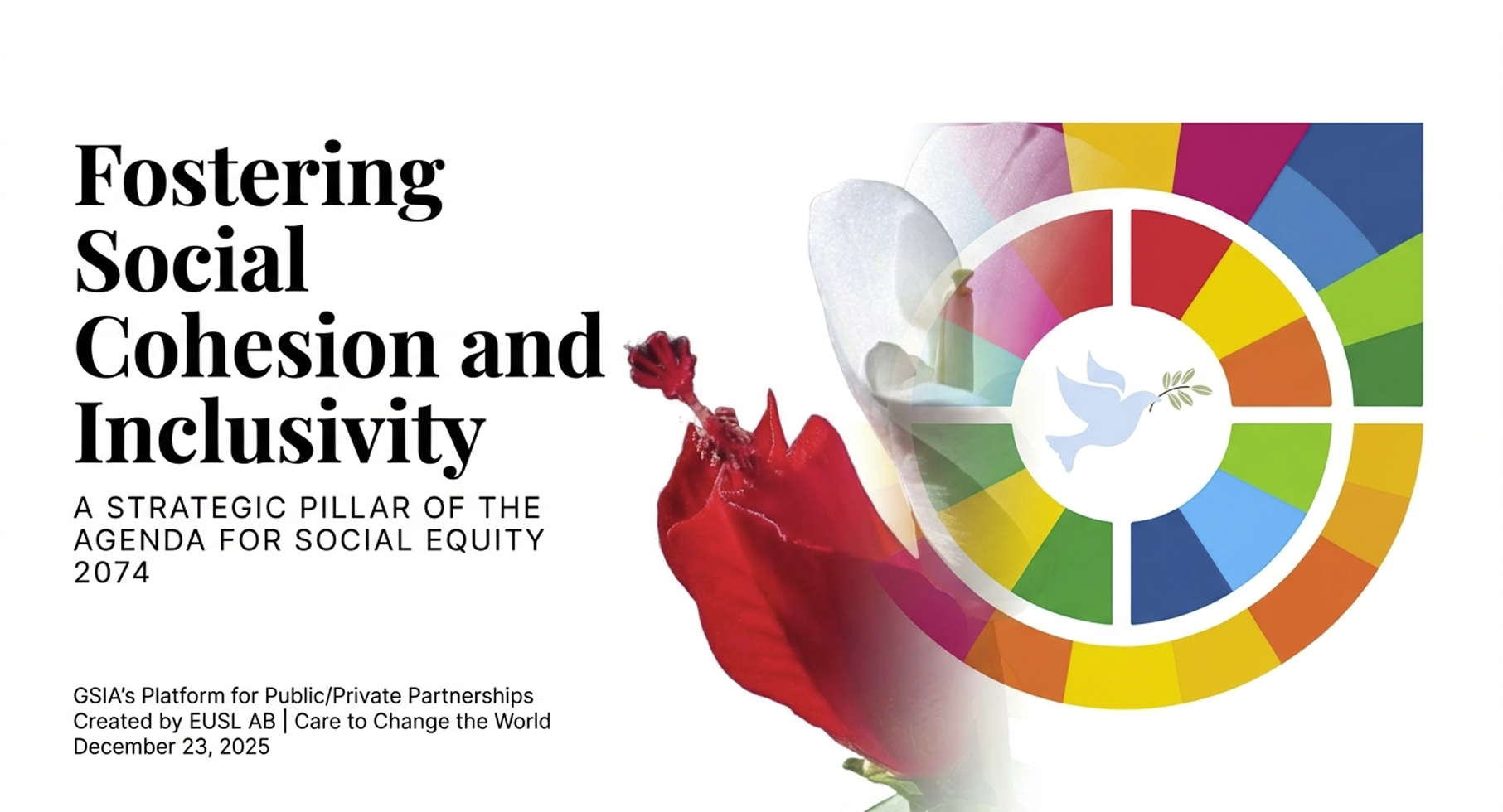
SGG 12: Fostering Social Cohesion and Inclusivity
A core pillar of the Agenda for Social Equity 2074, establishing a universal reference standard for cohesive, inclusive, and trust‑based societies in which diversity is respected and belonging is shared.
Goal Statement and Definition
Goal Statement
Ensure socially cohesive and inclusive societies in which individuals and communities experience belonging, mutual trust, and equal opportunity to participate in social, economic, cultural, and civic life, free from exclusion, polarization, and marginalisation.
Definition
For the purposes of Agenda 2074, social cohesion and inclusivity refers to the capacity of societies to sustain peaceful, cooperative, and pluralistic relationships across differences in identity, origin, belief, ability, age, and socio‑economic status. Cohesion requires inclusive institutions, shared norms of respect, and mechanisms for dialogue, participation, and conflict resolution that enable diversity without fragmentation and unity without exclusion.
Strategic Rationale
Social cohesion is a precondition for stable, equitable, and democratic societies. Where trust erodes and exclusion deepens, polarisation increases, collective problem‑solving weakens, and institutions lose legitimacy. Fragmented societies are less resilient to crises, more susceptible to misinformation, and less capable of sustaining long‑term social progress.
Agenda for Social Equity 2074 therefore treats social cohesion not as a soft social outcome, but as a structural equity condition. Cohesive societies require inclusive governance, equitable access to opportunity, and visible pathways for dialogue and participation. Fostering inclusivity strengthens mutual trust, reduces conflict, and enables diverse communities to coexist and cooperate across social, cultural, and generational lines.
Targets
In order to realise this goal, institutions across the public, private, cooperative, and civil‑society spheres should, as a minimum:
- Prevent and counter social exclusion, marginalisation, and discrimination in all institutional and societal settings.
- Promote inclusive participation in community, civic, cultural, and public life across diverse population groups.
- Strengthen social trust through transparent institutions, community dialogue, and conflict‑resolution mechanisms.
- Support intercultural understanding, solidarity, and shared responsibility across differences in identity and background.
- Ensure that grievances related to exclusion, discrimination, or social harm can be raised and resolved safely and fairly.
Targets are relational and institutional in nature and may be adapted to different social contexts, provided that inclusion and cohesion remain central objectives.
Indicative Indicators
Progress under SGG 12 may be illustrated through proportionate, non‑financial indicators, including but not limited to:
- Participation rates in community, civic, and cultural activities across population groups.
- Presence and accessibility of dialogue, mediation, and conflict‑resolution mechanisms.
- Institutional policies and practices promoting inclusion and non‑discrimination.
- Public trust and perceived belonging indicators derived from surveys or consultations.
- Frequency and resolution of grievances related to exclusion, discrimination, or social conflict.
Indicators emphasize belonging, trust, participation, and conflict management rather than demographic composition alone.
Alignment with Global and Regional Frameworks
Social Global Goal 12 complements and extends the social inclusion dimensions of the United Nations Sustainable Development Goals, particularly SDG 10 (Reduced Inequalities), SDG 11 (Sustainable Cities and Communities), and SDG 16 (Peace, Justice and Strong Institutions), by framing social cohesion as a governance and equity imperative.
The goal aligns with the African Union’s Agenda 2063, notably Aspiration 3 (An Africa of Good Governance, Democracy, Respect for Human Rights, Justice and the Rule of Law) and Aspiration 5 (Africa with a Strong Cultural Identity, Common Heritage, Shared Values and Ethics), by emphasizing unity in diversity, inclusive societies, and shared civic belonging.
In European contexts, SGG 12 complements the European Green Deal by addressing the social cohesion dimensions of transition. It reinforces the principle that sustainable transformation requires inclusive narratives, fair processes, and social trust to prevent polarization and social fragmentation during periods of structural change.
Position within Agenda 2074