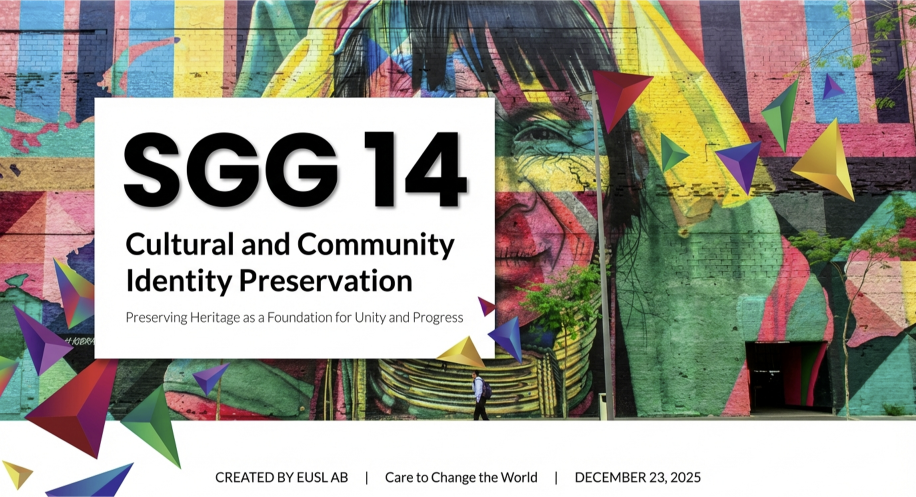
SGG 14: Cultural and Community Identity Preservation
A core pillar of the Agenda for Social Equity 2074, establishing a universal reference standard for safeguarding cultural heritage, community identity, and collective memory as foundations of dignity, social cohesion, and intergenerational continuity.
Goal Statement and Definition
Goal Statement
Ensure the preservation, protection, and continued vitality of cultural heritage and community identities, enabling individuals and communities to maintain meaningful connections to their history, traditions, languages, and shared spaces while participating fully in contemporary social life.
Definition
For the purposes of Agenda 2074, cultural and community identity preservation refers to the safeguarding of tangible and intangible cultural expressions, including language, traditions, knowledge systems, arts, practices, and shared places, as well as the social bonds that sustain community life. Preservation encompasses protection from erasure, marginalisation, or exploitation, and support for living cultures that evolve responsibly across generations without loss of dignity or authenticity.
Strategic Rationale
Cultural heritage and community identity provide individuals with orientation, belonging, and continuity across time. Where cultures and local identities are eroded—through displacement, homogenisation, conflict, or neglect—social cohesion weakens, trust declines, and individuals experience loss of meaning and alienation. Such erosion disproportionately affects indigenous peoples, minority communities, rural populations, and displaced groups, compounding social inequities.
Agenda for Social Equity 2074 therefore treats cultural and community identity as a structural social asset, not a discretionary cultural concern. Preserving heritage and identity strengthens resilience, supports intergenerational knowledge transfer, and reinforces social cohesion in times of rapid economic, technological, and environmental change. Cultural continuity is essential for inclusive development and for the legitimacy of institutions operating within diverse societies.
Targets
In order to realise this goal, institutions across the public, private, cooperative, and civil‑society spheres should, as a minimum:
- Protect tangible and intangible cultural heritage from destruction, neglect, and unlawful appropriation.
- Safeguard the rights of communities to maintain, express, and transmit their cultural identities across generations.
- Prevent displacement, cultural erasure, or loss of community cohesion resulting from development, conflict, or transition processes.
- Enable inclusive participation in cultural life and equitable access to cultural spaces, practices, and expressions.
- Ensure that cultural preservation efforts are community‑led, respectful, and free from exploitation or commodification without consent.
Targets are culturally sensitive and context‑adaptive, provided that dignity, authenticity, and community agency remain central.
Indicative Indicators
Progress under SGG 14 may be illustrated through proportionate, non‑financial indicators, including but not limited to:
- Existence and enforcement of legal and institutional protections for cultural heritage and community identity.
- Community access to cultural spaces, practices, and intergenerational transmission mechanisms.
- Inclusion of cultural and heritage considerations in development, planning, and recovery processes.
- Participation of communities in decisions affecting their cultural assets and identities.
- Availability of grievance and redress mechanisms related to cultural harm, erasure, or misappropriation.
Indicators emphasize continuity, participation, and cultural agency rather than symbolic representation alone.
Alignment with Global and Regional Frameworks
Social Global Goal 14 complements the cultural and social inclusion dimensions of the United Nations Sustainable Development Goals, particularly SDG 11 (Sustainable Cities and Communities) and SDG 16 (Peace, Justice and Strong Institutions), by positioning cultural heritage and identity as components of social equity and governance legitimacy.
The goal aligns closely with the African Union’s Agenda 2063, notably Aspiration 5 (Africa with a Strong Cultural Identity, Common Heritage, Shared Values and Ethics), by emphasizing cultural continuity, community resilience, and shared identity as cornerstones of unity and development.
In European contexts, SGG 14 complements the European Green Deal by recognising the role of cultural heritage and local identity in place‑based transition strategies. It supports approaches to sustainability that respect historic communities, cultural landscapes, and social memory while adapting to environmental and economic change.
Position within Agenda 2074