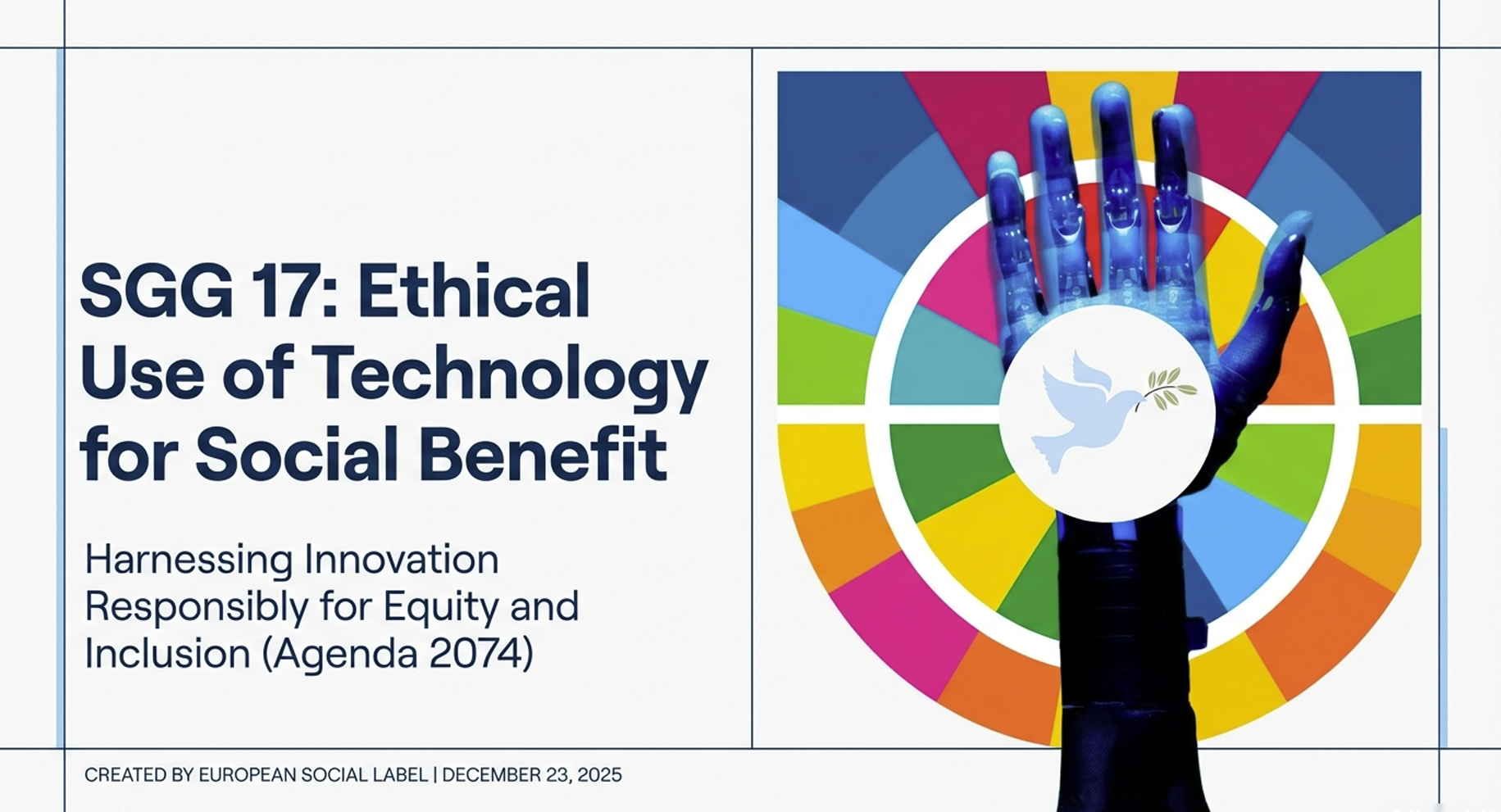
SGG 17: Ethical Use of Technology for Social Benefit
A core pillar of the Agenda for Social Equity 2074, establishing a universal reference standard for the ethical, inclusive, and accountable use of technology in service of social equity, human dignity, and democratic integrity.
Goal Statement and Definition
Goal Statement
Ensure that technological development and deployment serve the public interest by promoting social benefit, protecting human dignity, and preventing harm, exclusion, and abuse through ethical governance, accountability, and inclusive design.
Definition
For the purposes of Agenda 2074, ethical use of technology for social benefit refers to the design, governance, and application of digital and emerging technologies— including data systems, artificial intelligence, automation, and platform infrastructures—in ways that respect human rights, ensure fairness, protect privacy, and enhance social outcomes. Ethical use requires transparency, contestability, proportionality, and human oversight, and rejects narrow optimisation that prioritises efficiency or profit at the expense of equity and trust.
Strategic Rationale
Technology increasingly mediates access to services, work, information, civic participation, and opportunity. When poorly governed, technological systems can entrench inequality, automate discrimination, erode privacy, and displace accountability. Conversely, when ethically designed and governed, technology has the capacity to expand access, improve service delivery, strengthen democratic participation, and support inclusive development.
Agenda for Social Equity 2074 therefore treats technology not as an autonomous force, but as a social instrument whose legitimacy depends on governance. Ethical technology use is a cross‑cutting condition for all other Social Global Goals—from access to services and education, to work, participation, and governance. Progress under this goal ensures that technological change reinforces, rather than undermines, social equity over the long horizon to 2074.
Targets
In order to realise this goal, institutions across the public, private, cooperative, and civil‑society spheres should, as a minimum:
- Ensure that technologies affecting individuals and communities are designed and deployed with explicit social purpose and public‑interest safeguards.
- Prevent discrimination, exclusion, and harm arising from automated or data‑driven decision‑making systems.
- Guarantee transparency, explainability, and human oversight in high‑impact technological applications.
- Protect privacy, data integrity, and personal autonomy through proportional and rights‑based data governance.
- Enable accountability, redress, and remediation for individuals and groups adversely affected by technological systems.
Targets are technology‑agnostic and future‑proofed, ensuring applicability to evolving digital and emerging technologies.
Indicative Indicators
Progress under SGG 17 may be illustrated through proportionate, non‑financial indicators, including but not limited to:
- Existence of ethical technology governance frameworks and oversight mechanisms.
- Use of impact assessments, bias testing, and human‑in‑the‑loop safeguards for high‑risk systems.
- Transparency and explainability measures for automated decision‑making affecting rights or access.
- Availability of grievance, appeal, and remediation pathways related to technological harm.
- Inclusion of affected communities in the design, deployment, and review of technological systems.
Indicators emphasize governance, accountability, and human impact rather than technological sophistication alone.
Alignment with Global and Regional Frameworks
Social Global Goal 17 complements the innovation and governance dimensions of the United Nations Sustainable Development Goals, particularly SDG 9 (Industry, Innovation and Infrastructure), SDG 10 (Reduced Inequalities), SDG 16 (Peace, Justice and Strong Institutions), and SDG 12 (Responsible Consumption and Production), by framing technology as a social equity issue rather than a purely technical domain.
The goal aligns with the African Union’s Agenda 2063, notably Aspiration 3 (An Africa of Good Governance, Democracy, Respect for Human Rights, Justice and the Rule of Law) and Aspiration 1 (A Prosperous Africa Based on Inclusive Growth and Sustainable Development), by emphasising ethical digitalisation, inclusive innovation, and sovereign governance over technological systems.
In European contexts, SGG 17 complements the European Green Deal and the EU’s digital governance agenda by reinforcing the principles of trust, accountability, and human‑centric technology. It supports the requirement that digital and green transitions proceed in ways that protect rights, prevent exclusion, and strengthen democratic legitimacy.
Position within Agenda 2074