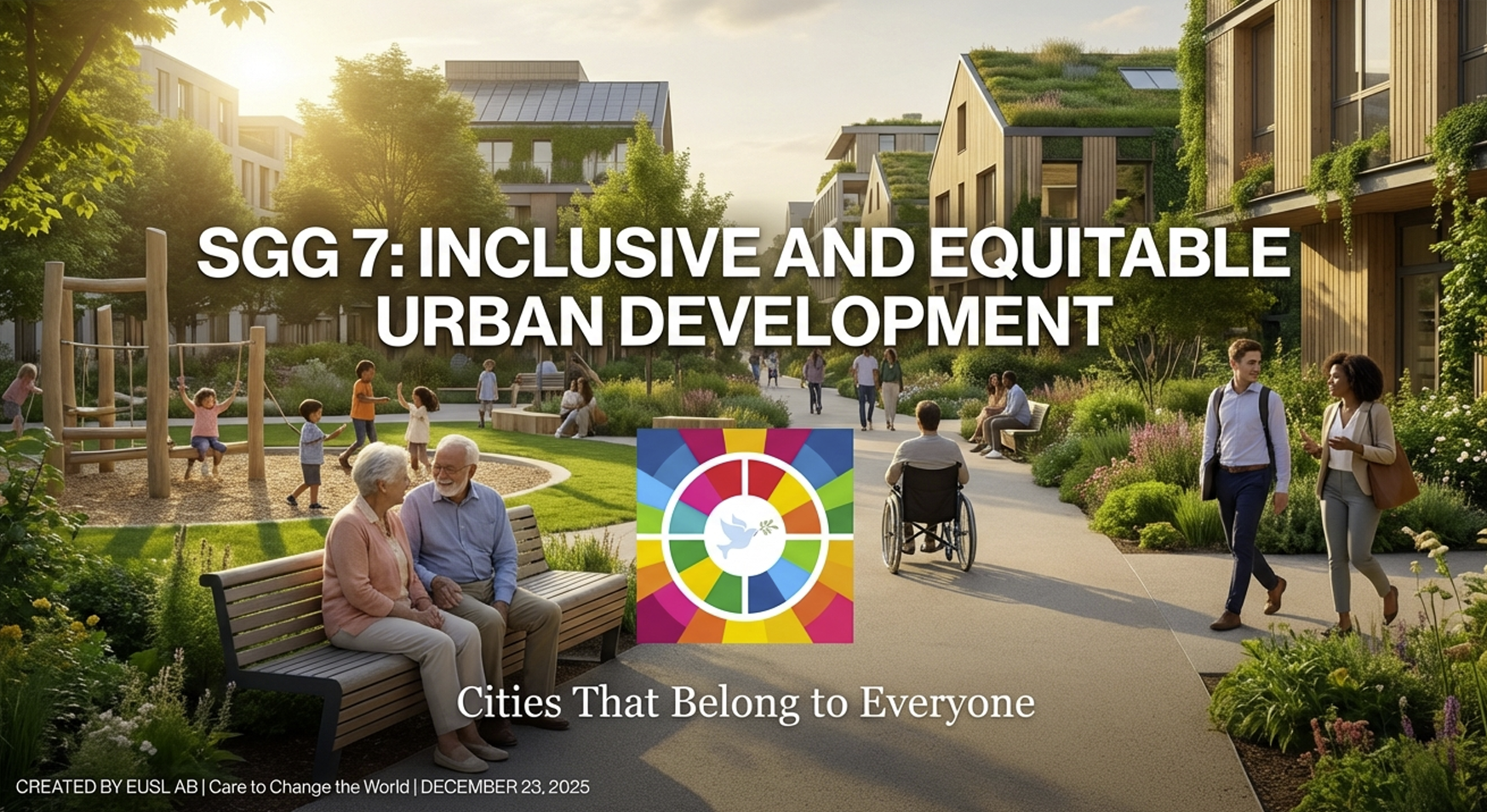
SGG 7: Inclusive and Equitable Urban Development
A core pillar of the Agenda for Social Equity 2074, establishing a universal reference standard for inclusive, equitable, and socially sustainable urban and spatial development.
Goal Statement and Definition
Goal Statement
Ensure that urban and peri‑urban development is inclusive, equitable, and socially sustainable, providing all residents with safe, accessible, and affordable living environments that enable dignity, participation, and opportunity.
Definition
For the purposes of Agenda 2074, inclusive and equitable urban development refers to the planning, governance, and management of cities and settlements in ways that prevent spatial exclusion, segregation, and inequitable access to housing, services, infrastructure, mobility, and public space. Equity in urban development requires that growth, renewal, and densification processes safeguard social cohesion, protect vulnerable populations, and balance environmental, economic, and social objectives without displacement or marginalisation.
Strategic Rationale
Urban areas are both engines of opportunity and loci of inequality. When urban development is poorly governed or market‑exclusive, it intensifies spatial segregation, informal settlements, housing insecurity, and unequal access to services, employment, and civic space. Such patterns undermine social trust, weaken public institutions, and generate long‑term economic and social costs.
Agenda for Social Equity 2074 therefore treats urban equity as a structural social condition, not a technical planning outcome. Cities must function as platforms for inclusion, access, and participation, rather than as mechanisms for exclusion or displacement. Inclusive urban development integrates housing, mobility, services, environmental quality, and governance into coherent social systems. Progress under this goal directly supports social stability, resilience, and intergenerational equity in increasingly urbanised societies.
Targets
In order to realise this goal, institutions across the public, private, cooperative, and civil‑society spheres should, as a minimum:
- Ensure access to safe, affordable, and adequate housing without displacement or discriminatory practices.
- Provide equitable access to essential services, infrastructure, and public spaces across urban and peri‑urban areas.
- Prevent and reduce spatial segregation through inclusive planning, zoning, and land‑use governance.
- Ensure accessible, safe, and affordable mobility systems that support participation in work, education, and community life.
- Promote participatory urban governance, enabling residents to influence decisions affecting their living environments.
Targets are adaptable across settlement sizes and governance contexts, provided that inclusion, equity, and social sustainability remain central.
Indicative Indicators
Progress under SGG 7 may be illustrated through proportionate, non‑financial indicators, including but not limited to:
- Housing affordability and security indicators across income and demographic groups.
- Spatial distribution of essential services and public infrastructure within urban areas.
- Patterns of segregation, displacement, or informal settlement growth.
- Accessibility and safety of public transport and active mobility networks.
- Existence and effectiveness of participatory planning and grievance mechanisms.
Indicators prioritize access, inclusion, spatial justice, and participation rather than physical expansion metrics alone.
Alignment with Global and Regional Frameworks
Social Global Goal 7 reinforces the urban equity commitments of the United Nations Sustainable Development Goals, particularly SDG 11 (Sustainable Cities and Communities), while strengthening linkages to SDG 10 (Reduced Inequalities), SDG 9 (Industry, Innovation and Infrastructure), and SDG 6 (Clean Water and Sanitation) by framing urban development as a social equity issue.
The goal aligns with the African Union’s Agenda 2063, notably Aspiration 1 (A Prosperous Africa Based on Inclusive Growth and Sustainable Development) and Aspiration 4 (A Peaceful and Secure Africa), by emphasizing inclusive urbanisation, equitable access to services, and socially cohesive cities as foundations for stability and development.
In European contexts, SGG 7 complements the European Green Deal by addressing the social dimensions of sustainable urban transition. It reinforces the principle that climate‑neutral cities must also be socially inclusive, ensuring that housing, mobility, and infrastructure reforms do not exacerbate inequality or displacement.
Position within Agenda 2074